Peaslee and the exchange of consciousness with the major race
The Colour Out of SpaceThe exchange of consciousness between Nathaniel Wingate Peaslee and the Great Race of Yith is the rupture that divides Peaslee’s ordinary life from five years in which he inhabits his own body without access to his identity or past. It begins with a sudden collapse during a university lecture and becomes visible through an unfamiliar voice, expression, and manner of using the body. Its consequences extend beyond memory: Peaslee’s family regards the person who awakens as an alien usurper, while his returning self must reconstruct the missing years from records and from the life that consciousness left behind.
Before the Exchange
Before May 1908, Peaslee’s life followed a conventional academic and domestic course. He was born and raised in Haverhill, entered Miskatonic University at eighteen in 1889, studied economics at Harvard after graduating, and returned to Miskatonic in 1895 as an instructor in Political Economy. He married Alice Keezar in 1896; their children were born in 1898, 1900, and 1903. He became an associate professor in 1898 and a full professor in 1902. He had no interest in occultism or abnormal psychology, a contrast that makes the alteration less an extension of an existing obsession than an intrusion into a life he had regarded as stable.
The first signs came shortly before the collapse. On Thursday, May 14, 1908, Peaslee experienced brief, chaotic visions, a headache, and a new sensation that someone else was trying to take possession of his thoughts. At about 10:20 in the morning, while teaching Political Economy VI to juniors and a few sophomores, he saw unfamiliar shapes and felt himself to be in a grotesque room rather than his classroom. His thoughts and speech wandered from the lesson; then he slumped unconscious in his chair. The episode turns an inward disturbance into a public, witnessed break in his life.
The Body Under Another Consciousness
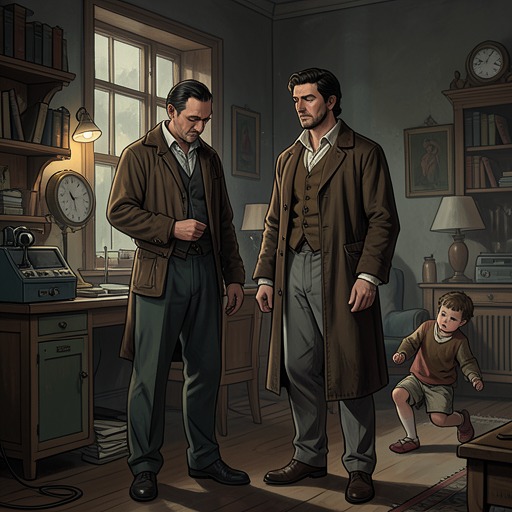
Peaslee’s own account of what followed is necessarily incomplete: he learned the first details from other people. Removed to his home at 27 Crane St. and given medical attention, he showed no sign of consciousness for sixteen and a half hours. At 3 a.m. on May 15, his eyes opened. The person who spoke then had no apparent memory of Peaslee’s identity or former life, yet initially seemed anxious to conceal that ignorance. Doctors and family were frightened by the unfamiliar direction of his language and by facial movements that did not look like Peaslee’s.
The change was bodily as well as mental. The new consciousness used Peaslee’s vocal organs clumsily, spoke in a stiff and laborious manner, and had to relearn how to use his hands, legs, and body more generally. Physical strength returned at once, but ordinary bodily competence did not. That disparity makes the body an uneasy boundary: it remains recognizably Peaslee’s, yet its movements and expressions betray a person who has not learned to inhabit it as he did. The returning Peaslee later insists that the mind, voice, and expression of the being who awoke were not his own.
Once attempts to hide the memory loss failed, the new occupant admitted it and became eager to acquire knowledge. Doctors observed an unusual pattern: he worked to master subjects ranging from history, science, art, language, and folklore, including matters both highly abstruse and very elementary, while seeming to lose interest in Peaslee’s personal identity. At the same time, he displayed knowledge of obscure events from remote ages and made occasional references to the future that startled listeners. These flashes soon stopped appearing openly; observers could not tell whether the knowledge itself had faded or whether the speaker had learned to conceal it. His avid study of contemporary language, customs, and perspectives made him seem like a traveller trying to learn the age into which he had arrived.
The Missing Years and Their Human Cost
The consciousness occupying Peaslee’s body used his resources to travel and study, including at American and European centres of learning. The journeys were unusually directed toward remote places: a month in the Himalayas in 1909, a camel trip into the unknown deserts of Arabia in 1911, a chartered voyage north of Spitzbergen in the summer of 1912, and weeks alone in the vast limestone caverns of western Virginia later that year. The returning Peaslee could not discover what happened on these expeditions. Their destinations survived as outward facts, while the purpose and experience of the journeys remained inaccessible to him.
The domestic rupture was more immediate. Alice Keezar regarded the awakened person with horror and loathing and maintained that an alien had taken her husband’s body. In 1910 she obtained a legal divorce and would not see Peaslee even after he returned to normalcy. His elder son and young daughter shared the family’s revulsion, and he never saw either of them again. The exchange therefore separated more than memory from its owner: it altered the relationships through which Peaslee might have resumed his former life, leaving legal and emotional consequences that persisted after his consciousness returned.
His second son, Wingate Peaslee, was the exception. Though only eight when the change occurred, Wingate believed that his father’s proper self would return. After it did, he sought Peaslee out, and the courts granted Peaslee custody of him. In later years Wingate helped with the studies that continued to occupy his father; at thirty-five, he was a professor of psychology at Miskatonic University. His loyalty provides a counterpoint to the family’s fear, but it does not undo the losses: one relationship is renewed, while the others remain broken.
Return and Significance
Peaslee’s own faculties did not again look out on the ordinary world for five years, four months, and thirteen days after the collapse. That precise interval gives the episode the shape of a displacement rather than a brief lapse: the body continued to live, travel, and form a public history, but Peaslee could not experience those years as himself. When his consciousness returned in 1913, he had to learn what had happened from old newspapers, scientific journals, and the people who remembered the altered man. Even the account of his own absence is therefore assembled from evidence left by others.
The exchange is significant because its effects remain legible in ordinary human particulars: a lecture interrupted, unfamiliar use of hands and voice, journeys whose meaning cannot be recovered, a divorce, lost contact with two children, and a son who waited for his father to return. The bodily signs first made the change visible; the family’s reactions made its cost lasting. Peaslee’s return restores his own consciousness, but not the unbroken continuity of his former life. The years belong both to the person who occupied his body and to the man who must afterward confront their consequences.